
Down Memory Lane
Wed, 04/21/2021 - 3:17pm
admin
Cresco baseball over the years

By:
Al Skoda
CRESCO - [Editor’s Note: One of my favorite parts of the job is learning about local history. Al Skoda is just one of my Cresco resources. I’m lucky he also likes to write. He recently reminisced about his memories of Cresco baseball and is sharing that with our readers.
Anyone else who would like to put something down in writing about what life was like when he or she was younger is welcome to send it in. We will gladly print it in our new column, “Down Memory Lane.”]
The start of Major League Baseball brought memories of my baseball years, starting at a young age. These memories will be passed on to my children, grandchildren and great-grandchildren.
My Early Days of Baseball
Kessel Park had a small baseball diamond and a group of us guys played on it. We always drew names to make two teams. One day, someone mentioned “let’s make a two-team league (north and west).
We took the bags (bases) and home plate from the small diamond and made a larger diamond. I was asked to make a schedule, so I decided on 14 games — two games a week throughout the summer.
Each player had a baseball glove, we got a catcher’s face mask from the school, and we had old baseballs. For bats, I went out to the fairgrounds and looked for “broken bats.” I found two of them, took them home and nailed them together. It was hard to do, but it worked. Those broken bats were from the Cresco Town Team.
The first year, we tied 7-7. So the following year, we played 15 games.
I was on the West Team, and we won eight games to seven. Every night when we played, the manager of the A&P Grocery, Bill Strowman, saw us go by his house. He and his son jumped in their car and headed for Kessel Park. He wanted his son to play, so we let him play, and Mr. Strowman had to umpire.
After each game, some of us would jump on our bikes and head for the Black and White Cafe. It was owned by Arnold Baker and he would make a 10¢ milkshake for us. He treated us very well. The malts were large, so we shared.
Assumption High School
In my four years of high school, I was a starter on the baseball teams, the first two as a catcher. We did okay. Our records were 9-3 (freshman year) and 8-4 (sophomore). The second two years, I was a pitcher. During these two years, we had a coach who did not know anything about baseball. He said we would not play baseball. I told him that I could coach the team. He said, “OK, let’s give it a try.” We did well, 9-3 record my junior year and 10-2 as a senior. All of the players gave it their best.
1948: Decorah Area League
In 1948, going into my senior year, I wanted to try out for the Cresco Town Team, but the Cresco Board said no try-outs. Let the older players finish the year. Due to this, we made up a team and joined the Decorah Area League. We won the league with a 12-1 record.
When we played in Cresco, we played double-header games. We played the first game, and the town team played the second one. I was catcher for the young team and batted third in the line-up.
We only chose 10 players, so everyone was active — Orv Herold (manager/pitcher), Paul Sir (pitcher), Al Skoda (catcher), Joe Zender (first base), John Murray (second), Arlis Gunderson (shortstop), Gene Aberg (third), John Wildman (left field), Gene Lybbert (center) and W. Kratz (right).
Cresco Amateur Town Baseball Team
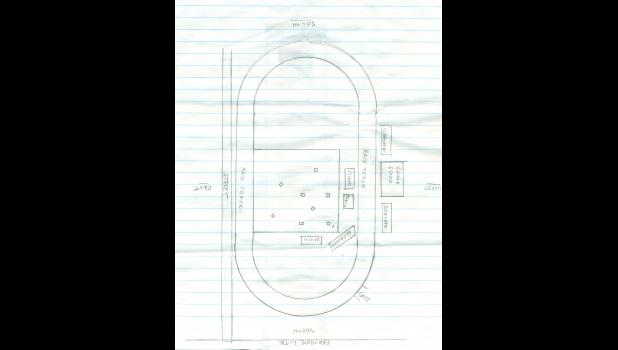
The Cresco team diamond was located in the fairgrounds, east of the grand stand and race track. This is where the town team played its home baseball games for many years.
Going back a few years, I remember some of the players — Ed, Merle and Melvin Benson, John Brickner, Stan Gerke, Denis Kapler, Art Pecinovsky, Paul Kolbet, Hal Bingfort, Ray Murray, Bob Wildman, Avery Kostka, Keith Kelly, Ed Kaderabek and Walt Bateman, to name a few.
Cresco played in the Northeast Iowa League along with Calmar, Festina, New Hampton, Elma, Lourdes, Spillville and St. Lucas.
New Baseball Lights
In 1949, new lights were added to the baseball diamond. This allowed for more games during the week.
The members of the board decided to have a grand opening and invited the Austin Packers Baseball Team. In 1948, the Packers were the champs of amateur baseball in Minnesota. They came to Cresco with most of the same players.
In 1949, Cresco added several players as new young starters — Paul Sir (pitcher), Al Skoda (catcher), Joe Zender (first), Arlis Gunderson (shortstop) and John Wildman (outfield). They also had Pete Kruger and Larry Gunderson (both pitchers).
They joined the Cresco players of Ed Benson, Merle Benson, Melvin Benson, Ray Murray, Bob Wildman and Cec Conry.
The Austin manager/catcher (Blackburn) was a former player with the New York Yankees for 10-12 years. When Mr. Blackburn came up to bat, he wanted to do a little visiting. As catcher, he started visiting with me as the umpire just watched.
He said we had a good young team. I thanked him for saying that. The first pitch to him was a strike. The second pitch was a change-up, swing and miss. Strike two. He said, “Wow! What a pitch.”
He asked if I was going to call for that pitch again. I paused for a moment and said, “Yes. I think I will.”
Change-up pitch again for strike three. He said, “I didn’t think you would do that.” He followed that by asking how old the pitcher was. I responded he was 18. He asked how old I was. I told him 19.
The crowd was very large, with maybe 200-plus. The bleachers were loaded, as well as the outfield lines. It took a while to “pass the hat” for collection.
By the way . . . Cresco won the game 5-2!
Pop Stand
For many years, the fairgrounds had a two-story “Time Stand” between the race track and baseball diamond (east of the grandstand). The upper booth was used for car/horse races. The lower part was used mostly for storage.
In 1944, I was about 13. I talked to Charles Nichols of the fair board and asked if I could rent the lower part and sell pop during baseball games. He said it was a good idea, and I could go ahead and give it a try.
The crowds at the ball games were always large. Bleachers were always full, with standing crowds down the sidelines. Some people even sat in cars. Weekend games were always called Sunday entertainment.
I talked to the Coke man, and he brought me a cooler and 15 cases of pop. My dad helped me get blocks of ice and did the chopping. Each bottle of pop cost 2¢, and I was able to sell a bottle for 5¢. I always sold 12-13 cases each game. In 1946, the cost went up to 4¢ a bottle, so I had to sell at an odd price or 10¢ a bottle. Sales went down to about 10 cases per event. I did not enjoy selling at 10¢ a bottle, so 1946 was my last year.
