
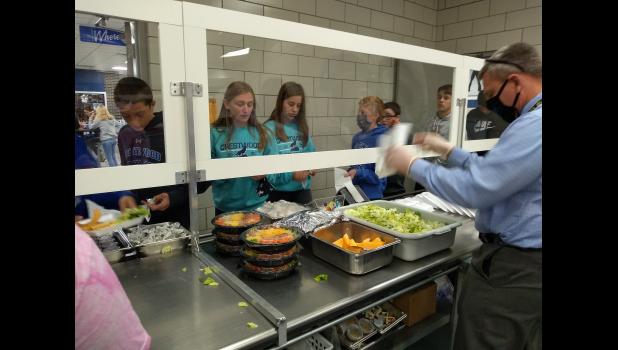
School lunches comparison
Wed, 10/28/2020 - 10:06am
admin
—A lot has changed since 1970

By:
Marcie Klomp ~ News Editor tpdeditor@crescotimes.com
HOWARD COUNTY - Earlier this month, Oct. 12-16, was National School Lunch Week.
Just for fun, staff decided to look at numbers, comparing 1970 to 2020. A lot of change has taken place in the past 50 years at the local Howard-Winneshiek Community School District.
For the school year 1970-1971, there were 2,359 students enrolled at Crestwood. In addition, Notre Dame (K-12) was 536.
That is compared with the enrollment at How-Winn. for 2020-2021 at 1,150 and 166 for Notre Dame K-6.
This shows a 55% decline in enrollment. There are many factors that come into play — fewer family farms, smaller-size families, private schools (Amish and Mennonite communities) and homeschooling.
Number of meals
Inflation since 1970 has increased 571%. What was $1.00 then now costs $6.71.
School lunches have also seen an increase. (These figures do not include Notre Dame.)
In 1970, there were 250,000 noon lunches served (242,833 for students and 13,586 for adults). In the 2018-2019 school year, there were 163,475 served (50,834 — free; 20,185 — reduced; 73,185 — paid; and 19,410 — non-reimbursable).
Breakfast was not mentioned in the Oct. 7, 1970 Times Plain Dealer article, but figures were given for the current program. There were 18,345 — free; 5,218 — reduced; 10,036 — paid; and 133 — non-reimbursable.
In addition, there were 4,780 summer breakfast meals served, along with 17,484 lunches.
Costs
In 1970, the cost of the program was $117,860, which included $70,751 for the cost of food; $34,176 for labor; and $12,933 for equipment. That figures out to 59.8% designated for cost of food; 29% for labor; and 11.2% for equipment.
It might be hard to imagine that food service prices for the 2018-2019 school year were $810,153.26. These were divided into food costs, salaries and benefits, supplies and other costs.
• In 2018-19, food costs were just under $400,000 at $395,959.74. That included National School Lunch Program (NSLP) — $255,043.31; Summer Breakfast Program (SBP) — $32,716.32; and summer food costs — $29,945.85.
• Salaries and benefits are also figured into the cost of food service. That total cost was $361,199.81 and includes $289,959.10 — NSLP; $37,195.23 — SBP; and $34,045.48 — Summer service.
• The total for supply costs two years ago were at $32,825.76. That included NSLP — $26,351.42; SBP — $3,380.29; and summer program — $3,094.05
• Other costs were at $20,167.95 and included ser-vice, equipment and all others.
The food costs took up 49% of the budget; salaries and benefits was 45%; supplies were 4%, and other costs were 2%.
Revenue
In 1970 students paid $83,901, while adults paid $3,939, with the remaining of $30,020 being subsidized by the government.
The 2018-2019 year showed $606,352 in program food revenue. That includes federal reimbursement of NSLP — $258,287, breakfast program — $51,676 and summer food program — $779,775; $5,048 for state reimbursement of NSLP — $4,096 and breakfast — $952; and program meal sales of $211,566 of lunch — $191,727 and breakfast — $19,839.
Program is in black
The Howard-Winneshiek food service program has seen significant improvements under the direction of Cheryl Dickman. For the past eight years or so, the cost of student lunches has not been increased.
Dickman explained she tries to keep the food costs as low as she can; this shows in the percentage of funds used for food in the comparison years. In 1970, the food cost was about 60% for the budget and 29% for salaries and benefits. Today the numbers are 49% and 45% respectively.
With fewer expenses on product, the program is able to save money and run in the black, unlike many programs around the state. This allows the department to use the money for other items, such as the new tables purchased several years ago. The fund has to be spent down again, and Dickman is working with Building and Grounds Director Larry Trende on reorganizing the lunch room to be more socially distant.
Free breakfast/lunch
For 2020-2021, all families will benefit from a government program that is funded through the end of the shool year, allowing free breakfast and lunch for every student, regardless of income. It had been available through the end of the year but was pushed back to the end of the school year.
