
FF1 — Training to save lives, property
Fri, 02/04/2022 - 3:23pm
admin

By:
Beki Groenwald TPD Staff
LIME SPRINGS - “I’m not sure people in our communities recognize how much work and training goes into being a volunteer fireman,” Jeff Wendel, the instructor for Firefighter One class, says. “This is 160 hours of hard work. Four hours a night, twice a week, and sometimes on Saturdays as well.”
Firefighter One, the nationally-certified, basic skills firefighter training and accreditation course held at the Lime Springs Community Center, is “a starting fire class for people who want to be firefighters,” according to Wendel. It covers 18 units with 27 chapters of “The Essentials for Fire Fighting, 7th Edition”: everything from Personal Protective Equipment to Tactical Ventilation, from Ropes and Knots to Property Conservation and Scene Preservation.
An equal balance of textbook learning and hands-on practical skills, the course isn’t just for volunteer firefighters. “This is the same training you’d get in a college class,” Wendel says. “I’ve had students go on to full-time, paid firefighting positions in bigger cities like Rochester, Des Moines, etc.”
And Wendel should know. He’s been teaching this course for over 15 years.
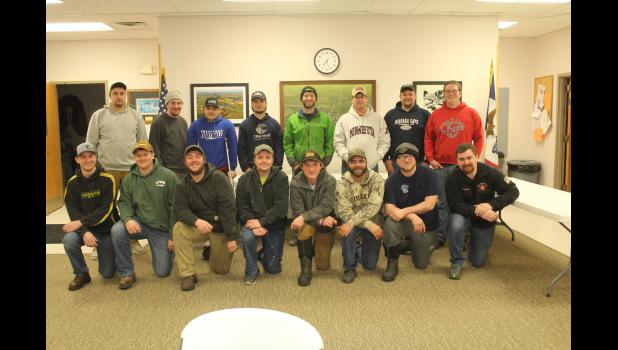
Accredited by the Fire Service Training Bureau in Camp Dodge, Wendel, who became a firefighter in 1977 and is Chester’s current fire chief, travels all over Iowa and Minnesota teaching this course. This year’s class has 23 students representing six different volunteer fire departments, Cresco, Lime Springs, Chester, Ridgeway, Preston and Canton.
The class began in October and Wendel hopes to finish in March, at which time students will take a certification test and do hands-on skills for outside evaluators. “It’s left up to individual departments whether to require certification or not,” Wendel says. But even if the tests aren’t all passed, the students have still garnered invaluable skills and information to assist them in their daily firefighting lives.
Drills
Two important practical skill drills are the one minute drills. Practiced many times during the course of the class, students have one minute to don their personal protective equipment (PPE) to a fire-ready status.
A second one minute drill gives them a single minute to don and initiate their self-contained breathing apparatus (SCBA). These air packs and tanks are essential equipment for fire fighters and must never be out of reach in a fire.
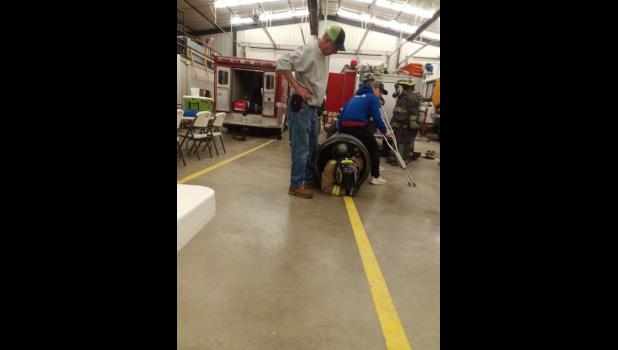
Close quarters drills require students to remove their SCBA and push it in front of themselves as they shimmy and crawl their way through pipes as narrow as 18 inches in diameter. This close quarters training is amazingly claus- trophobic. “Several students didn’t think they could do it, but they proved themselves wrong,” Wendel says proudly.
During close quarters drills and other practical training, it is of the utmost importance for students to keep their hands on the SCBA pack at all times. In a smoky building or a hot fire, it is very easy to lose track of something they were just touching, so keeping a hand on the SCBA no matter what else they are doing is essential fire safety impressed on students by repetitive drills with the SCBA on their backs or in hand.
“I try to keep the training fun,” Wendel says. “I have them walk around town and climb ladders, play dodgeball and softball. I have them in their whole turnout, their PPE and SCBA so they get used to being active using these packs. So they see how much air they consume and understand the differences of their abilities in how they move. It’s like a breathing exercise. The SCBA, that’s their life safety. If it’s not done right, it won’t protect them.”
Other training
But every hands-on experience isn’t a drill. The Fire Service Training Bureau (FSTB) offers Mobile Prop Training in a variety of scenarios such as forcible entry, vehicle extrication, car fire and more. FSTB Mobile Prop Training is fully funded by the Iowa Volunteer Firefighter Training Fund and available at no cost to volunteer firefighters.
One such Mobile Prop Training scenario, the Burn Trailer, is coming to Lime Springs in late February. “The trailer is brought in on a flat bed and LP [gas] fired,” Wendel explains. “They throw in a couple of hay bales for heat and smoke, then students go in and put it out.”
Why volunteer?
All this sounds like a young man’s idea of adventure heaven, but it might surprise some to find that, when asked why they joined a volunteer fire department, the answer was very consistent — to help their community.
First generation firefighter Ben Hron, 22, became a volunteer firefighter to help Chester. He wanted to “help his community when they need help the most.” Hron worked in the Chester Fire Department for three months before starting the Firefighter One class. He says the class has really helped him, particularly the drills for getting all that PPE on inside one minute.
Hunter Fousek, 21, also of Chester, has been around firefighting and firefighters most of his life. His dad is a volunteer firefighter, so he grew up with it. He says he would always think the fires looked exciting. But he also wants to help his community. That’s a major reason — to help his community and neighbors.
Trevor Lange of Preston became a volunteer firefighter last March. “The class is really helpful,” he says. It makes them more confident in what they know. And when asked why he chose to become a firefighter? He wants to help his neighbors and community.
“You take it to heart,” Wendel says. “You do it to help neighbors and your local community. Many people don’t understand that.”
But these men do. They understand it and put it to the task every time a fire bell rings, and they don their PPE in one minute, strap their SCBA to their back, and prepare to face the flames in defense of someone they may or may not know. A neighbor. A member of their community. You.
What is the FSTB?
“The Fire Service Training Bureau [FSTB] is designated by statute to be the State Fire Academy,” Bureau Chief John Kraemer writes. “We have been training Iowa’s firefighters and other emergency service responders since 1923. We are home to the second-longest continually running annual state fire school in the nation.
“The Bureau coordinates and instructs many basic and advanced level courses at our facility and also locally across the state in the subject matter areas of firefighting, hazardous materials, vehicle extrication, technical rescue, instructor development, officer development, fire prevention, traffic incident management (TIMS) and fire investigation, to name just a few. We also offer multiple National Fire Academy direct-delivery courses annually.
“We are accredited by the International Fire Service Accreditation Congress (IFSAC) and are authorized to issue [Firefighter One] certifications following completion of the respective training class and both written and practical skills examinations.”
“In addition to our facility having on-site training grounds to conduct live-fire training evaluations, we have multiple mobile training props that can be requested to be delivered for local community-based training.”
The mission of the FSTB is to “establish credibility in providing quality education, training, certification and professional consultation to Iowa’s fire service and other emergency responders in a manner that reflects commitment, integrity and contributes to the reduction of morbidity, mortality and property loss from fire and other hazards.”
