
Sometimes ‘Jack-of-all-Trades’ can lead to success
Fri, 09/25/2026 - 10:11am
admin
~ 1978 Crestwood Graduate Dan Wendl used it to become VP of Trane®

By:
Daniel Evans - TPD Publisher
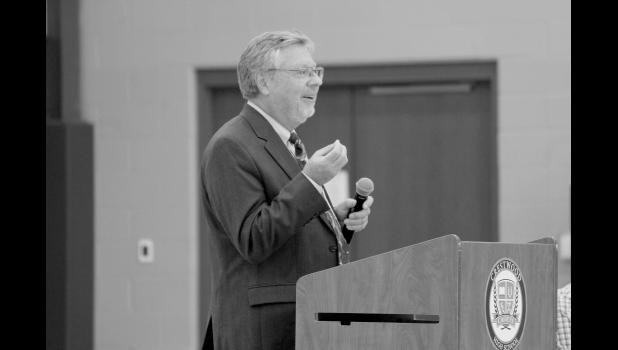
EDITOR’S NOTE: This is the fourth and final part of a four-part series on the speakers at the All-School Reunion Program, held during the 2026 Norman Borlaug Harvest Fest. Four outstanding graduates of Crestwood High School presented speeches––this week is Dan Wendl.
CRESCO - When it comes to learning, you often turn to family, teachers, pastors/priests, and other community members to get that knowledge, which can lead to being a “jack-of-all-trades” as you’re growing up. For Dan Wendl it led to becoming Vice-President of Trane® Technologies, a $21 billion a year company.
His skills, after earning a degree in engineering from Iowa State, allowed him to become a registered professional engineer in several states––allowing for numerous awards throughout his career and several positions in organizations, boards and more.
At Trane® his 41-year career included marketing, sales, operations, information technology, productivity, business transformation, systems oversite and executive leadership––again, showing he was the “jack-of-all-trades” at the company. His career also allowed him to reside in numerous states managing and leading business activities/operations in the U.S., Canada, Europe and Latin America.
Of his honors, his extensive professional experience and notoriety is well exemplified as a member and past Chairman of the ISU College of Engineering Advisory Board, past Chapter President of ASHRAE and professional involvement and contribution to BOMA, US Green Building Council and the Presidential Roundtable. Wendl is also the recipient of the Joseph K. Walkup Prominence in Industrial Engineering Award, presented by ISU.
In recent years, upon retirement, Wendl has located back to NE Iowa from North Carolina and is the proud father of four grown children and four grandchildren.
Wendl Opens Up Talk
“I think anyone who knows me, or has seen me recently, knows how much I love Northeast Iowa,” said Wendl, who attended both Notre Dame and Crestwood and loves visiting the area whenever he can. “What I learned growing up in Cresco and becoming an adult was that it all started here and everything became a progression of all those different pieces that you didn’t even realize would impact you.”
Wendl noted that “two different categories of major things” influenced him with the first being a “jack-of-all-trades” and the other, “is the impact others bring to affect your personality, traits and skills.”
“While in school everyone kind of needed you to do everything, and that type of experience happened all the time, right?” pointed out the speaker. “Some of the traits that you were working on, kind of rubbed off on others and equally the other way around, such as hard-work, ethics and more. Meanwhile, because you were involved in so many things, you really didn’t specialize in anything, but it gave you a vision of a bigger picture of things to come.”
He stated that you “kind of knew a lot about many different kinds of things”, so you had a bigger point of view once you attended college, started your working career and even in family. Wendl added that the farm life also was important as you learned stuff relative to business, such as showing up to work on time, learning to respect others and treating others as you would treat yourself.
“The other thing you learned is having to figure things out, learning about practicality, and sometimes having the humility needed to accomplish what you did, because you were so dependent on hothers on how to get things done.”
Wendl commented that you also established relationships with “so many different people” when you were involved with the many different activities––and that sort of stuff––getting skills from teachers, parents, your parents’ parents, in spending that time together as friends and classmates.
Getting back to the jack-of-all-trades aspect of his speech, Wendl noted that he took part in several different sports in his high school years. “I was in five different sports when I went to school hear, and wasn’t particularly good at any of them. But I was in five different sports, sometimes two in one season, right? I was in a lot of different groups there and was the GM of one of them.”
He explained that in Crestwood “wrestling was the thing to do,” and was so big and popular it could humble a person.
“It showed that your expectations may be different from others,” stated Wendl. “I mean it can really humble someone––even when I had a home basketball game, my parents would choose to to to an away wrestling meet!”
Another change was for Wendl was transferring from a Catholic School to Crestwood, having already learned plenty but wanting to experience more in high school. “You had chemistry, shop class and all these different classes. It helped with that practicality feature as you had to put things together and take things apart. With chemistry, science and math you could even be part of the nerd group and the athletic group all at the same time, because it was all available to you, here at Crestwood. Even art was available and I enjoyed that sort of stuff too, so I learned artistic things—engineering oriented things––which I ended up using at college.”
He stated that creativity led to great things, such as building a real river through the cafeteria with a moat and drawbridge for junior prom. “I mean, you don’t do that stuff unless you can get away with it. Also, when building floats you used those skills to always make something interesting––again, getting you involved, establishing new relationships and more.”
Wendl stated that one thing he learned from his father early in life was to “never look up and never look down, but always treat everybody the same.”
“That really carried through my work life. Whenever I was working late at night, I would have some great conversation with the janitor working those odd hours. And whenever I had to go talk with the CEO of the company, you just looked the person in the eye and never looked up or looked down.
At school he commented that there was a little distinction between the farm kids and the town kids.
“I was effectively a town kid, right?” stated Wendl, whose family had a retail business in town. “Fortunately, I also got to be a bit of a farm kid because my grandparents had a farm and my aunt and uncle had a farm––so I often got to go and help out with that. It was there I learned a little about business as Grandma would pay us a penny for every fly we would kill, which was great as a six/seven-year-old. Eventually you would get paid for mowing and then help paint, but it created that drive.”
He stated he equally learned at the retail store downtown. “l didn’t know it at the time, but I was learning business without even knowing I was learning business! My parents would be doing payroll at the kitchen table or setting up work schedules and we would often go to the store and help with inventory or help make sure there was good cash flow coming in as my parents would change up the store to attract new customers and keep the usuals.”
As the VP of a huge corporation, Wendl noted that he took those “tools” learned in an early age and used them as he grew at Trane®. “It was just a progression of what I already learned when I was younger. I just kept moving the decimal point over as I was getting into different positions. It basically went from pennies at the farm to bigger dollars and bigger business, as I continued to grow throughout my career.”
In closing he started talking about teamwork and how that was also learned in Crestwood. His example was running on a relay team with someone coming at you full blast, you had to time your start perfectly to receive that baton, or you were loosing seconds. “You were dependent on that person handing off that baton as much as you were to receive it. In business, you also have to take it all in, such as those in finance, those in HR, engineering, manufacturing and all that stuff. You’re dependent on all those things for success.”
Wendl, in closing, talked about respect and how Cresco was the type of town that seemed to always “look out for you.”
“They all did––your teachers, your parents, those in the community––which was something really cool,” added the speaker. “Some that you really didn’t want to look our for you, also did. Some of my classmates’ mothers I was really scared of, and still am!”
To finish, Wendl again commented on the jack-of-all-trades, which actually allowed him to connect with so many people through work, college and more. “You could talk about anything with anybody.” He also added that the many “traits learned” allowed him the skills needed to succeed in his job, his life.
“Really, about the only thing that I’m actually feeling bad about-–and this does really bother me––was that I was so blessed to have grown up in this little town, go to these wonderful schools, yet not able to send my own kids and own grandkids here! I truly wish I could have done that.”bring to affect your personality, traits and skills.”
“While in school everyone kind of needed you to do everything, and that type of experience happened all the time, right?” pointed out the speaker. “Some of the traits that you were working on, kind of rubbed off on others and equally the other way around, such as hard-work, ethics and more. Meanwhile, because you were involved in so many things, you really didn’t specialize in anything, but it gave you a vision of a bigger picture of things to come.”
He stated that you “kind of knew a lot about many different kinds of things”, so you had a bigger point of view once you attended college, started your working career and even in family. Wendl added that the farm life also was important as you learned stuff relative to business, such as showing up to work on time, learning to respect others and treating others as you would treat yourself.
“The other thing you learned is having to figure things out, learning about practicality, and sometimes having the humility needed to accomplish what you did, because you were so dependent on others on how to get things done.”
Wendl commented that you also established relationships with “so many different people” when you were involved with the many different activities––and that sort of stuff––getting skills from teachers, parents, your parents’ parents, in spending that time together as friends and classmates.
Getting back to the jack-of-all-trades aspect of his speech, Wendl noted that he took part in several different sports in his high school years. “I was in five different sports when I went to school here, and wasn’t particularly good at any of them. But I was in five different sports, sometimes two in one season, right? I was in a lot of different groups there and was the GM of one of them.”
He explained that in Crestwood “wrestling was the thing to do,” and was so big and popular it could humble a person.
“It showed that your expectations may be different from others,” stated Wendl. “I mean it can really humble someone––even when I had a home basketball game, my parents would choose to go to an away wrestling meet!”
Another change for Wendl was transferring from a Catholic School to Crestwood, having already learned plenty but wanting to experience more in high school. “You had chemistry, shop class and all these different classes. It helped with that practicality feature as you had to put things together and take things apart. With chemistry, science and math you could even be part of the nerd group and the athletic group all at the same time, because it was all available to you, here at Crestwood. Even art was available and I enjoyed that sort of stuff too, so I learned artistic things—engineering oriented things––which I ended up using at college.”
He stated that creativity led to great things, such as building a real river through the cafeteria with a moat and drawbridge for junior prom. “I mean, you don’t do that stuff unless you can get away with it. Also, when building floats you used those skills to always make something interesting––again, getting you involved, establishing new relationships and more.”
Wendl stated that one thing he learned from his father early in life was to “never look up and never look down, but always treat everybody the same.”
“That really carried through my work life. Whenever I was working late at night, I would have some great conversation with the janitor working those odd hours. And whenever I had to go talk with the CEO of the company, you just looked the person in the eye and never looked up or looked down.
At school he commented that there was little distinction between the farm kids and the town kids.
“I was effectively a town kid, right?” stated Wendl, whose family had a retail business in town. “Fortunately, I also got to be a bit of a farm kid because my grandparents had a farm and my aunt and uncle had a farm––so I often got to go and help out with that. It was there I learned a little about business as Grandma would pay us a penny for every fly we would kill, which was great as a six/seven-year-old. Eventually you would get paid for mowing and then help paint, but it created that drive.”
He stated he equally learned at the retail store downtown. “l didn’t know it at the time, but I was learning business without even knowing I was learning business! My parents would be doing payroll at the kitchen table or setting up work schedules and we would often go to the store and help with inventory or help make sure there was good cash flow coming in as my parents would change up the store to attract new customers and keep the usuals.”
As the VP of a huge corporation, Wendl noted that he took those “tools” learned in an early age and used them as he grew at Trane®. “It was just a progression of what I already learned when I was younger. I just kept moving the decimal point over as I was getting into different positions. It basically went from pennies at the farm to bigger dollars and bigger business, as I continued to grow throughout my career.”
In closing he started talking about teamwork and how that was also learned in Crestwood. His example was running on a relay team with someone coming at you full blast, you had to time your start perfectly to receive that baton, or you were loosing seconds. “You were dependent on that person handing off that baton as much as you were to receive it. In business, you also have to take it all in, such as those in finance, those in HR, engineering, manufacturing and all that stuff. You’re dependent on all those things for success.”
Wendl, in closing, talked about respect and how Cresco was the type of town that seemed to always “look out for you.”
“They all did––your teachers, your parents, those in the community––which was something really cool,” added the speaker. “Some that you really didn’t want to look our for you, also did. Some of my classmates’ mothers I was really scared of, and still am!”
To finish, Wendl again commented on the jack-of-all-trades, which actually allowed him to connect with so many people through work, college and more. “You could talk about anything with anybody.” He also added that the many “traits learned” allowed him the skills needed to succeed in his job, his life.
“Really, about the only thing that I’m actually feeling bad about-–and this does really bother me––was that I was so blessed to have grown up in this little town, go to these wonderful schools, yet not able to send my own kids and own grandkids here! I truly wish I could have done that.”
